

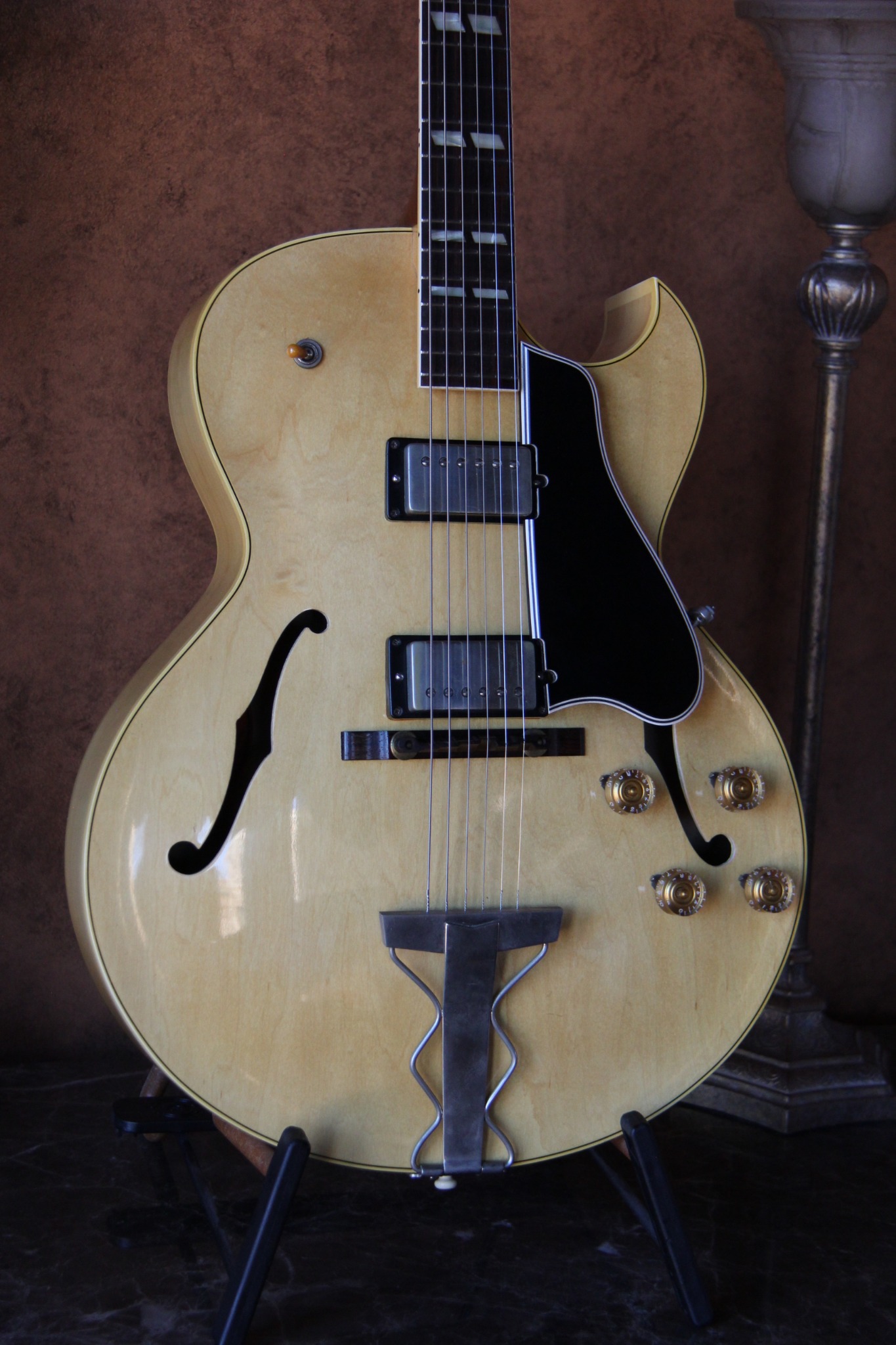
Gary’s Story
The ES-175 has always represented something different to me from the Les Paul, Stratocaster or ES-335. Those guitars became closely associated with the commercial world of rock and blues. The ES-175 became, perhaps more than any other electric guitar, the working jazz guitarist’s instrument.
Think about the players associated with it: Joe Pass, Jim Hall, Herb Ellis, Howard Roberts, Kenny Burrell, Pat Metheny — and even Steve Howe in an entirely different musical setting.
Joe Pass has always been my favorite. His recordings, particularly the Virtuoso period, were an enormous influence on me. His long association with an ES-175 made the guitar something I always wanted to own.
My own experience with the model goes back to when I was about 18 and working and teaching at Taylor’s Music House. They had an early-’70s Norlin-era ES-175 that Mark Grimm and I would play when the store was quiet. It had a very thin neck, but it was great fun to play and it left an impression on me that never really went away.
Many years later I began seriously looking for the right vintage example. I didn’t simply want an old ES-175. I wanted an early Natural-finish, humbucker-equipped guitar in extraordinary original condition.
Eventually I found this one. A25149 came from its original owner and was offered through Firehouse Guitars in Michigan. It had been on the market for less than five days when I acquired it.
What makes the guitar remarkable is its state of preservation. For a 1957 instrument, it is extraordinarily original and exceptionally well preserved. It retains its original stickerless humbuckers, wiring harness, single-line Kluson tuners and buttons, pickguard, amber switch tip, single-ply truss-rod cover and even its almost-unplayed original frets. There is no finish checking, no cracks, no extra holes, no touch-ups and no repairs.
Even the Natural finish remains remarkably bright, and the laminated maple top and back have beautiful texture and movement. The Brazilian rosewood used for the fingerboard, bridge base and saddle is very dark and attractive.
But the thing that impressed me most didn’t really reveal itself until the guitar received a high-quality setup. It’s the acoustic resonance. This guitar has an almost natural-reverb quality when played acoustically. Notes seem to bloom inside the body, yet the response remains beautifully balanced from string to string.
The neck is substantial, with a measured nut width of approximately 1.713 inches. The neck pickup measures approximately 8.19kΩ and the bridge approximately 7.29kΩ. Resistance measurements don’t tell you what makes a great early Gibson humbucker special; what I hear is clarity and range combined with a mellow quality that suits this guitar beautifully.
This is one of those guitars I simply cherish spending time with.